
In Times of Crisis: Should You Rely on Gold or Stocks?

As a long-term investor, you’re likely focused on optimizing your portfolio for better risk-adjusted returns or reducing volatility. To do this, you or your chosen investment advisory might consider assets that add diversification.
Some investors prioritize protecting their portfolios during market crashes, while others may choose to hedge even in stable times. The choice of assets for this depends heavily on their unique features and current market conditions.
Gold, often seen as a “safe haven,” has been a popular choice for stability, while stocks are a go-to for growth. However, can these assets still hold strong during a crisis? If not, which one can you rely on for resilience during economic downturns? Let’s check.
How Do Investors Generally React To Crisis?
When a crisis hits, there’s often a lot of noise. Stock prices like that of Tata Motors share price and the indices take a fall, which usually impacts investors. Many investors react by panicking and selling their equity investments, even at a loss. This fear-driven response can be counterproductive, yet it happens repeatedly due to the worry of further losses. Finding suitable investments during a crisis can be challenging even if you don’t make a panic sale.
In such situations, issues to watch out for include high volatility in equity markets and the risk of a double-dip recession, which make investment decisions tricky in uncertain times. Take the recent situation in Ukraine. Initially, Indian stock markets declined, but they have since recovered considerably. However, the future of investments made now remains uncertain as the impact of the geopolitical stress on equity investments continues to unfold.
How Does Crisis Affect Gold Prices?
Economic downturns often drive up gold prices, as investors turn to the yellow metal for stability. Even minor disturbances, such as natural disasters or global crises, cause gold prices to fluctuate sharply.
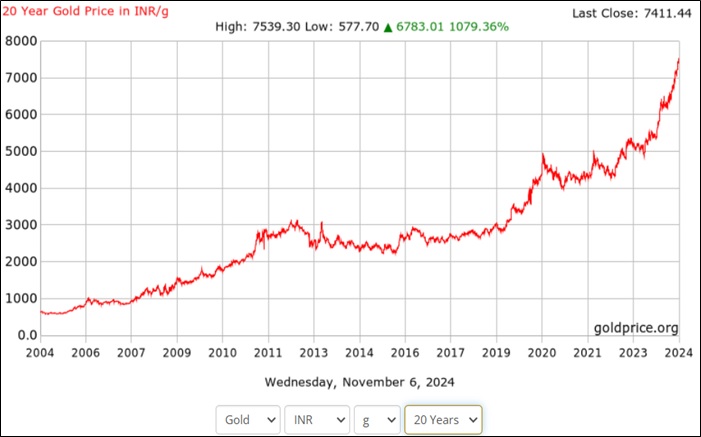
This pattern was evident during the 2008 recession and the Lehman Brothers collapse, which sent global markets tumbling. During this period, gold prices soared by 5.6% in 2008, 23.4% in 2009, and 29.5% in 2010.
In India, the gold price per 10 gm surged from Rs.12,500 in 2008 to Rs.48,000 in 2021, marking a 284% increase over 13 years. The COVID-19 pandemic sparked a similar rally, with gold prices rising 24.6% in 2020.
Limited economic activity and low bond yields made gold particularly attractive, and Indian investors continued to buy despite higher prices. While gold saw a mild 18.9% increase in 2021, previous years of calm, such as 2013-2015, showed declines of 28.3% and 10.4%.
Even during the Russia-Ukraine war, gold prices followed the same surge pattern. In India, gold prices rose sharply from Rs.50,180 per 10 grams of 24-carat gold on February 23, 2022, to Rs.51,550 the next day.
This sudden increase mainly reflected a surge in global gold prices, which also impacted the domestic market. Events like these reflect an international trend where gold shines as a reliable investment when stocks and bonds falter.
Source- GoldPrice
How Does the Stock Market React to Crisis?
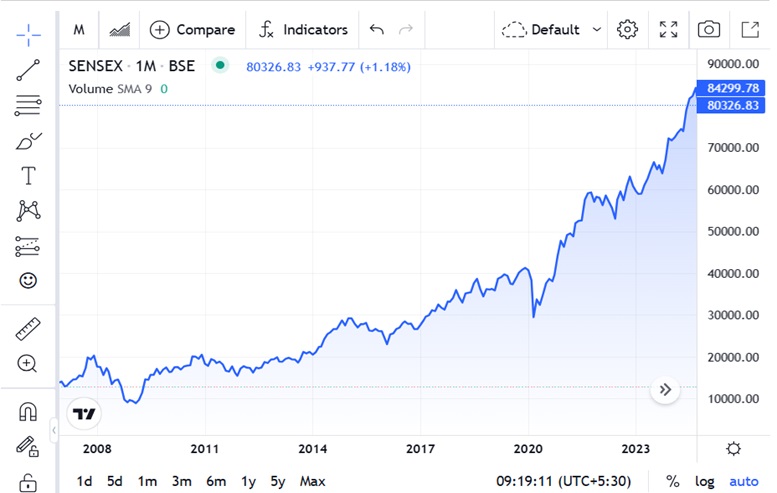
If we compare gold with the stock market, the stock market hasn’t fared well during similar crises in India. For instance, when gold prices surged during the pandemic market crash, the securities market wiped out Rs.13.88 lakh crore.
On 23rd March 2020, the Sensex plummeted by over 13%, shedding 3,935 points, while the Nifty dropped 13%, losing 1,135 points. Adding to the shock, the volatility index (VIX) surged to 71.56, marking a jump of 6.64%. Nearly all major large-cap stocks fell over 15% that day. But the downturn didn’t end there—it stretched across several days. In just a week, the Sensex dropped sharply from 42,273 to 28,288.
A similar decline occurred during the 2008 crisis when the Sensex dropped by 950 points (6%), bringing it below 15,000. Just two weeks earlier, it had already slipped by 900 points. Though the we financial crisis sparked the crash, it sent shockwaves worldwide, causing global markets to tumble. The impact on India was severe; between 2008 and 2009, the market lost 50% of its value from previous highs.
Source: MoneyControl
Can We Rely on Gold During Crisis?
Should we rely on gold or the stock market during a crisis? Considering past trends and figures, gold is a safety cushion to mitigate possible losses. But should you solely rely on it to safeguard all your investments?
The crises and the resulting market reactions are short-term scenarios. In uncertain times, investors often shift their money to “safe” sectors, industries, and asset classes like gold or other commodities. These investments can help limit equity portfolio losses to a certain extent. However, they don’t guarantee long-term wealth creation.
Though gold has delivered the best returns for the risk taken, offering both high returns and low risk over the past five years, it is important that you keep your portfolio balanced and diversify with other asset classes as well. With a well-diversified portfolio and regular rebalancing, short-term downfalls in equity markets become less of a concern.